 This
section offers evidence-based information about unwanted, coerced or
violently forced abortion in America. You'll also find downloadable
resources to learn and share.
This
section offers evidence-based information about unwanted, coerced or
violently forced abortion in America. You'll also find downloadable
resources to learn and share.
(See What is coercion? A
Legal Definition)
Contrary to popular
belief, a
growing body of evidence indicates that most abortions in America involve coercion.1,2
Those in positions of power, authority or influence may apply pressure,
blackmail, deceptive or negligent information, threats or even violence
-- or all of the above -- to coerce or even
force an
unwanted abortion.
Coercion can be direct, indirect or both,
often working synergistically during narrow windows of vulnerability or
duress.
It may involve unethical, negligent or
profit-driven counseling. It may include pressure from one's family, support
network or authorities; substandard medical and professional practices; or
abuses of power in various sectors of
society.
Coercion may happen in schools, medical
offices, or even in the helping professions. In other cases, it may
involve personal, emotional, financial or other forms of blackmail,
threats, abuse or violence.
Coercion can and does escalate. Some women have been abused, tortured or killed.
Others have literally experienced shotgun abortions after they
resisted an unwanted abortion. Homicide the leading killer of pregnant women.5.
(Learn more about
Forced Abortion in America.)
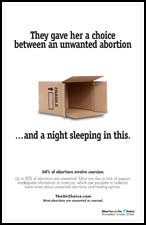 Research
shows that most women don't want abortion. Coercion
often exploits or endangers women who want to have their babies, or works
against individuals and families seeking answers, guidance and personal or
practical help, yet not told of alternatives ... or falsely told that no
practical or personal support or resources are available.
Research
shows that most women don't want abortion. Coercion
often exploits or endangers women who want to have their babies, or works
against individuals and families seeking answers, guidance and personal or
practical help, yet not told of alternatives ... or falsely told that no
practical or personal support or resources are available.
Coercion
may involve an abusive partner, family or authority figure; negligent or
coercive professionals in the helping professions or elsewhere; a passive,
coercive or even violent support network; deceptive, agenda- or
profit-driven experts presenting false information as fact, etc.
These
things often happen when women,
couples or families are seeking answers -- such as a pregnancy test -- guidance or a helping hand, often
from trusted authorities or other professionals.
Employers and others have threatened or inflicted physical harm, loss of job
or financial support, abandonment, or even death when women resisted an
unwanted abortion. (See Forced Abortion in
America.)
One mother was turned away from a homeless shelter unless she would have an
abortion. In other cases, it is an abuser who seeks abortion to cover up his
crimes. In still other cases, it is parents who force their daughters to
abort. One mother literally pushed her daughter at gunpoint into a clinic,
telling staffers to "ignore her if she gets a little teary." In another
case, parents literally locked their daughter in her room for two weeks
until it was time for her appointment.
Women have
suffered unthinkable abuses, torture and even death for
resisting abortion ... even in America and other free nations. Women and others hurt by abortion are often at a loss for words to
describe the experience. Words that do come up often are "silenced,"
"nightmare," "humiliating," "degraded," "dismissed," "herded like
cattle," "part of me died," and, ironically, "I was never given a
choice." (See
UnChoice Stories.)
Men have also experienced
deceptive counseling or the abortion of their wanted child.
Families have
lost not only unborn children but also daughters, sisters and friends to pregnancy or abortion-related abuses, violence or
post-abortion issues. (See
Women's Deaths from
Abortion, and Men and
Abortion.)
BEFORE ABORTION --the Synergy of
Direct or Indirect Coercion or Force
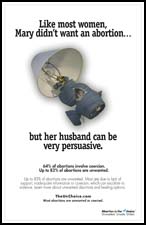
The Voices of Women Who've
Been There
"There were about 100 women
in the waiting room and no one was talking."
"We were herded like
cattle."
"I had so many questions. The
doctor told me to be quiet."
"Every Tuesday a scheduled bus
took students to the clinic. It was all so organized."
"The school counselor said, 'One
day you'll back on this and laugh."
Academic research backs up what
women have been saying for years, even though their voices are often
silenced, denied, dismissed or even mocked. Research indicates the "big
picture" multi-faceted nature of coercion, which can end in abuse,
unwanted abortions, violence or homicide if women resist. It's not just one but many
forces working in concert to prevent, not support, women and their
children:
The Synergy of Coercion:
-
52% felt rushed, 54%
uncertain,
-
64% feel pressured to abort, yet
-
67% had NO counseling
beforehand,
-
79% were not told of available
alternatives1
-
84% were not properly
informed.1
-
Coercion comes from all sides --
especially during times of vulnerability and uncertainty -- and can
escalate to violence or even homicide, the leading killer of pregnant
women. (see
Forced Abortion in America report for
details and citations)
2) AFTER ABORTION
Trauma, injuries, heartbreak and higher risk of mothers dying, too.
The Voices of Women Who've
Been There
"My sister was crying as she
entered the clinic, she cried throughout the procedure, and she was crying
as she left. Three children are growing up without their Mom because nobody
wanted to ask questions." -- Sister of post-abortion suicide
victim
"She typed her last words on a
synthesizer: 'Get in touch with my Dad. Tell him I love him." -- Susanne,
was paralyzed by and eventually died from abortion complications
"Many, many girls and women have
wound up in the emergency room of hospitals bleeding uncontrollably or
deathly sick from infection because the doctors botched their abortions.
Many, many of these girls and women have had to undergo hysterectomies.
Quite a number have died.: -- Kevin Sherlock in The Scarlet Survey
Facts Reflecting the
Abortion's Heartbreaking and Even Deadly Aftermath:
-
65% suffer symptoms of
Post-Traumatic Stress Syndrome
-
31% suffered health
complications, some of which are life-threatening
-
65%
higher risk of clinical depression
-
Death rates from all
causes are 4.5 times higher
-
Suicide rates are 6 times higher
Coercion an internationally recognized human rights abuse7
that is common, even in free nations.
Post-abortion issues are also a concern for many women, men and
families among us. Teens are especially at risk of coercion or
post-abortion issues, including suicide.
See also: How Common Is Coercion?
Downloads, Information and Resources |
Evidence-Based Resources:
The aftermath is equally heartbreaking and deadly.
Please download and share the user-friendly, research-based educational
materials on this site:
Portraits of Coercion flyer
Forced Abortion in
America fact sheet
Forced Abortion in
America flyer
Forced Abortion in America
26-page special report -- downloadable pdf format
Forced
Abortion in America report citations
What Every American Needs to Know
-- facts, download in postcard or flyer format
Top 10 Reasons it's The UnChoice
-- postcard and flyers
The UnChoice Definition
-- postcard or flyer
Teens Risks fact sheet
-- flyer (see also Teens
Page)
Physical Risks fact sheet -- helpful for teens or
women being coerced to deter family or authorities pressuring them to
have unwanted abortions
Psychological Risks fact sheet
-- helpful for teens or women being coerced to deter
family or authorities pressuring them to have unwanted abortions
What Insiders and Experts Say
About Coercion
Special Report -- Coercion Inside
the Abortion Industry
Wantedness and Coercion. Key Factors in Understanding Women's Mental Health
After Abortion. by Martha Shuping, M.D.
Abuse Can Take the Form of Forced Abortion by Dr. David Reardon
(published in the Canadian Medical Association Journal)
Center Against Forced
Abortions (off-site page)
Learn more about Pregnancy- and Abortion-Related Abuse, Violence,
Exploitation and Homicide
Forced Abortion page
Links about
unwanted abortions (off-site page)
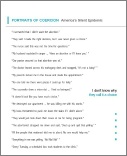
Voices of coercion, not support ...
 “I
screamed that I didn’t want the abortion.”
“I
screamed that I didn’t want the abortion.”
“They said I made the right decision, but I was never given a choice.”
“The nurse said this was not the time for questions.”
“My husband exploded in anger ... ‘Have an abortion or I’ll leave you.’
”
“Our pastor assured us that abortion was ok.”
 “The doctor leaned across his mahogany desk and snapped, ‘It’s not a
baby!’ ”
“The doctor leaned across his mahogany desk and snapped, ‘It’s not a
baby!’ ”
“My parents locked me in the house and made the appointment.”
“No one told me there were places I could go for help.”
“The counselor drew a micro-dot ... I feel so betrayed.”
“It doesn’t look like you have much choice.”
“He destroyed our apartment ... he was killing me with his words.”
“My
boss threatened to push me down the stairs if I didn’t abort.”
“They would just look down their noses at me for being pregnant.”
“The abortionist strapped me down and said, ‘Shut up and quit that
yelling.’ ”
“All the people that mattered told me to abort. No one would help me.”
“Everything in me was yelling, ‘No! No! No!’”
Download
Portraits of Coercion flyer
-- prints on 11 x 14-in. legal
size paper
Forced Abortion in America |
 | Forced Abortion --
Happening in Free Nations, Too
Coercion can escalate to violence, forced abortions or even murder.
Women have been forced into unwanted abortions; others
injured or killed for resisting. Some suffer unthinkable abuses,
even torture.
The rhetoric of choice suggests no pressure, no desperation, no
coercion ... personal or professional ...
direct or indirect, such as that reflected in withholding support or
even blackmail, ultimatums and threats. Concealing relevant
information or deceptive information presented as fact also acts
coercively.
|
Click here to download the Forced Abortion in America Report
(26-page booklet, pdf) |
Pressure often comes inside and outside the clinic. In addition
to deceptive and otherwise coercive counseling practices,
pressure from partners, family, friends or even abusers
plays a role. |
A former abortion clinic security guard testified before the
Massachusetts Legislature that the biggest aggressors at abortion
clinics were the men who accompanied their wives or girlfriends.3
Many pregnant women have been killed by partners trying to prevent the
birth, and women are more likely to be attacked while pregnant.4
Homicide is the leading cause of death among pregnant women.5
A few more excerpts from this disturbing report are printed below. For more
information, see the Forced Abortion in America
fact sheet,
flyer or
download the free 26-page
special report
Articles & News:
Resources
and help from the Center Against Forced Abortions
Abortion Exploits and Enslaves Women, Expert Warns
Study Linking Poor Pre-Abortion Counseling and PTSD Shows Need for New
Legislation
Holding Abortion Providers Accountable - legislative
initiative to protect women's rights
Judge: Abortion Provider Rushed Abortion on Sexually Abused Teen
Abuse Can Take the Form of Forced Abortion by David Reardon
(published in the Canadian Medical Association Journal)
More Off-Site Articles:
One Man's
Story -- a Humble Man's Admission of Coercion
Planned Parenthood to Pregnant Women -- Can't Help You without Abortion
Abortion
Decisions and the Duty to Screen
Two Senseless Deaths - A Heartbreaking Example of Medical Coercion
Center Against Forced Abortions - Resources for Teens, Families &
Pregnancy Centers
Abby Johnson: I Regret Selling Abortions at Planned Parenthood
Her Choice, Her Problem. How Abortion Empowers Men. by Richard Stith
Male Coercion and
Irresponsibility
...
Vesting all reproductive responsibility in the woman enables men to
rationalize their irresponsibility toward women who choose not to abort.
Abortion and Coercion -- She was very upset about her coerced
abortion three years ago. ... When she expressed this to her husband, he
told her to "Deal with it."
A Compelling Answer to Criticisms of Women Who Are Pro-Life After
Abortion --
UnChoice Stories and Personal Experiences
UnChoice
Stories
Unwanted
Abortions -- RealChoices - When not wanting an abortion doesn't matter
Citations
1. For information on these and
other cases, see the special report,
Forced Abortion in America.
2. VM Rue et. al., “Induced
abortion and traumatic stress: A preliminary comparison of American and
Russian women,” Medical Science Monitor 10(10): SR5-16 (2004).
3. Brian McQuarrie, “Guard,
clinic at odds at abortion hearing,” Boston Globe, April 16,
1999.
4. Julie A. Gazmararian et
al., “The Relationship Between Pregnancy Intendedness and Physical
Violence in Mothers of Newborns,” Obstetrics & Gynecology, 85
:1031 (1995); Hortensia Amaro et al., “Violence During Pregnancy and
Substance Use,” American Journal of Public Health, 80: 575
(1990); and J. McFarlane et al., “Abuse During Pregnancy and Femicide:
Urgent Implications for Women’s Health,” Obstetrics & Gynecology,
100: 27, 27-36 (2002).
5. I.L. Horton and D. Cheng,
“Enhanced Surveillance for Pregnancy-Associated Mortality-Maryland,
1993-1998,” JAMA 285(11): 1455-1459 (2001); see also J. Mcfarlane
et. al., "Abuse During Pregnancy and Femicide: Urgent Implications for
Women's Health," Obstetrics & Gynecology, 100: 27-36 (2002).
6. See our Research
Booklet for more on the physical and psychological effects of
abortion.
7.
United
Nations International Conference on Population and Development.