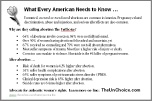
What every American needs to know
This ad, flyer or postcard message is an ideal
introduction to share with anyone who is new to this issue, especially those
who don't know that most abortions are unwanted or coerced, or about
heartbreaking aftereffects, including
higher maternal death
rates. This message is available
in many versions, suitable for general audiences.
 Choose
From Varied Formats and Headlines
Choose
From Varied Formats and Headlines
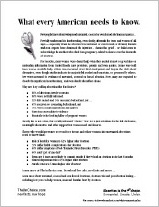
There are several versions of this ad/flyer, each with slightly varied
headlines for different audiences (other than the headline, the message
on each is the same. Choose regular or co-op versions, which space to
add your own message.
Read the complete text from "What Everyone
Needs to Know" message here: |
Few people know that most abortions are unwanted
or coerced. Abuse, employment discrimination and coercion that can escalate
to violence or even murder (homicide is the
leading killer of pregnant women) endanger and kill both the unborn and
women. (See death rate studies and
Forced Abortion in America.)
Few fully understand its heartbreaking, even
deadly, aftermath for teens and women of all ages — especially when the
abortion was unwanted, coerced or forced ... or if family, friends and even
experts dismiss widespread coercion, unwanted abortions, injury and
heartbreak ... or if they fail even to acknowledge those hurt or killed by
pregnancy- and abortion-related violence or to acknowledge families who have
lost a loved one in the aftermath of abortion.
For decades, many women and couples seeking facts
and assistance were denied help when they needed it most, pressured from all
sides, or given false or misleading information from trusted health care
providers, experts, parents and even pastors. Some were told there was no
available help. Others were deceived about fetal development and kept in the
dark about alternatives, even though studies indicate the majority felt
pressured by others or rushed and uncertain. Few were screened for unwanted,
coerced or forced abortion. Now, they’re left to absorb the significant,
heartbreaking and sometimes deadly aftereffects alone.
Why are they
calling abortion The UnChoice?
-
64% of women having abortions said they
felt pressured to abort.1
-
84% said they were not fully informed.1
-
52% felt rushed and 54% uncertain
beforehand1, yet
-
67% received no counseling beforehand1,
and
-
79% were not informed about alternatives.1
-
Most suffer trauma symptoms1
and face a significantly higher risk of injury or death after
abortion.2
-
Coercion can escalate to violence.3
-
Homicide is the leading killer of
pregnant women.3
This is not a free, fair or fully informed
“choice.” Nor is it a just substitute for the full disclosure, authentic
support, meaningful alternatives and other essentials that women need and
deserve.
Those who would pressure or even force teens
and women into unwanted abortions need to know that:
-
Risk of death for women is 62% higher
after abortion.4
-
31% suffer health complications after
abortion.1
-
65% suffer symptoms of Post-Traumatic
Stress Disorder (PTSD).1
-
60% said “part of me died.”1
-
Teens are 6 times more likely to commit
suicide if they’ve had an abortion in the last 6 months.5
-
Clinical depression risk is 65% higher
after abortion.6
-
Suicide rates are 6 times higher after
abortion.7
Learn more at
TheUnChoice.com. Download free ads, new facts and more ...
Learn more about unwanted, coerced and even
forced abortions; abortion risks and post-abortion healing ... including how
you can help women, men and families hurt by abortion.
Click
here to download this page for free as a flyer/ad.
Citations
1. VM Rue et. al., “Induced
abortion and traumatic stress: A preliminary comparison of American and
Russian women,” Medical Science Monitor 10(10): SR5-16 (2004).
2. See the
Recent Research fact sheet (pdf download).
3. See the special report,
Forced Abortion in America (pdf download).
4. M Gissler et. al.,
“Pregnancy Associated Deaths in Finland 1987-1994 -- definition problems and
benefits of record linkage,” Acta Obsetricia et Gynecologica Scandinavica
76:651-657 (1997).
5. B. Garfinkel, et al., “Stress, Depression and
Suicide: A Study of Adolescents in Minnesota,” Responding to High Risk Youth
(University of Minnesota: Minnesota Extension Service, 1986)
6. JR
Cougle, DC Reardon & PK Coleman, “Depression Associated With Abortion and
Childbirth: A Long-Term Analysis of the NLSY Cohort,” Medical Science
Monitor 9(4): CR105-112 (2003).
7. Mika Gissler, Elina Hemminki, Jouko
Lonnqvist, “Suicides after pregnancy in Finland: 1987-94: register linkage
study,” British Medical Journal 313:1431-4, 1996; and M. Gissler, “Injury
deaths, suicides and homicides associated with pregnancy, Finland
1987-2000,” European J. Public Health 15(5):459-63 (2005).